The Home Mining Boom Has a Catch
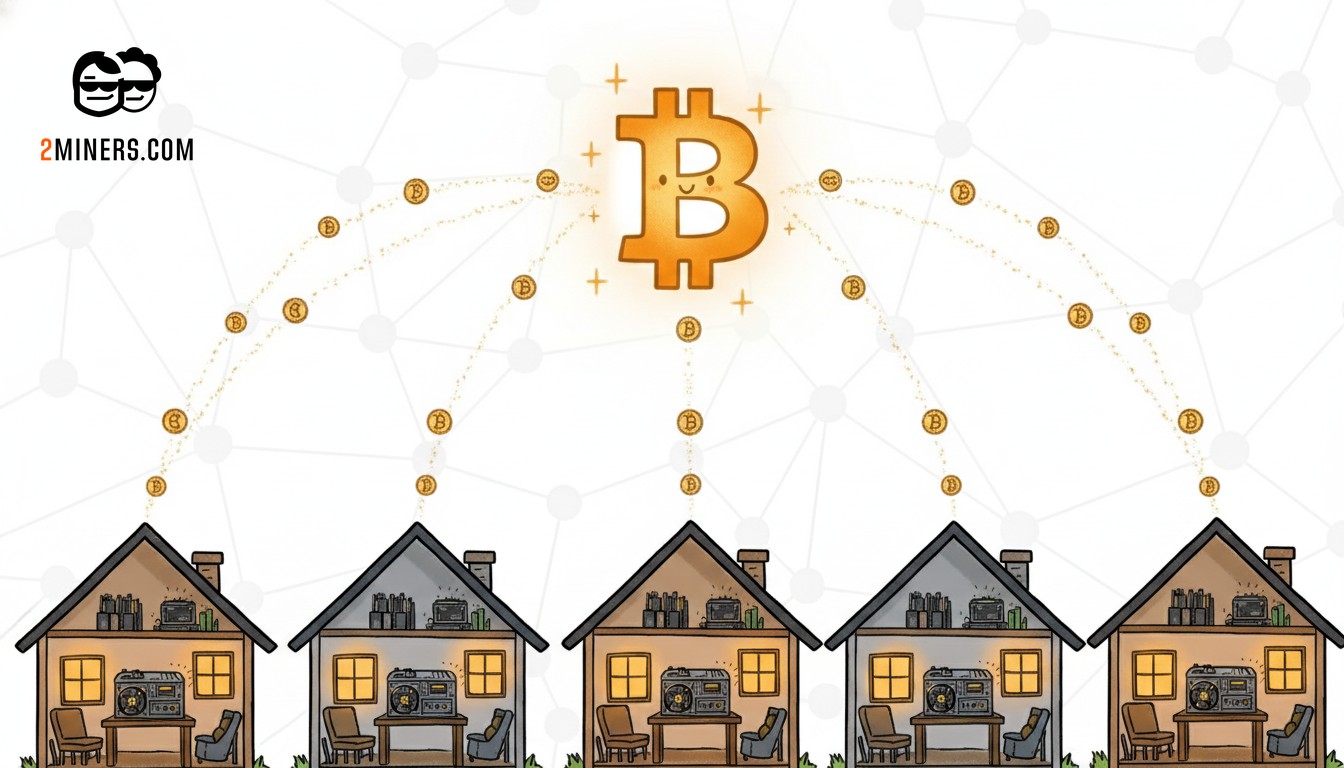
A new generation of quiet, low-power SHA-256 miners has put solo mining back on the desk. A Bitaxe draws less power than a phone charger. A Canaan Avalon Nano is the size of a router and runs near library-quiet. You plug it in, point it at a pool, and you are mining the same algorithm as a warehouse full of Antminers.
The catch is scale. Your home miner does 1 to 15 TH/s. The Bitcoin network does close to 1 ZH/s — that is a billion TH/s. Solo mining is a lottery, and on Bitcoin the jackpot odds are astronomical. But SHA-256 is not only Bitcoin. Bitcoin Cash (BCH) uses the exact same algorithm, the same hardware, and the same block reward — on a network a few hundred times smaller. That one fact changes everything about home solo mining.
Which Home SHA-256 Miners Actually Make Sense
Three categories cover almost everything people run at home today. For a deeper breakdown of individual micro miners, see our Bitcoin solo mining guide.
Plug-in lottery miners (open-source)
- Bitaxe Gamma: a single BM1370 chip, around 1.2 TH/s at 15–18 W. Open-source, near-silent, the reference home miner.
- NerdQaxe++: four BM1370 chips, roughly 4.8–6 TH/s at about 100 W. The high end of the open-source boards.
- NerdMiner V2: an ESP32 learning device measured in kH/s, not TH/s. Treat it as an educational toy — its real-world block odds are effectively zero.
Commercial desktop miners
- Avalon Nano 3: 4 TH/s at 140 W. Pocket-sized, app-managed.
- Avalon Nano 3S: up to 6 TH/s, as quiet as 36 dB, with lower-power modes. The sweet spot for a quiet home unit.
- Avalon Mini 3 / Avalon Q: 37.5 TH/s and 90 TH/s respectively — a lot more hashrate while staying quiet (Avalon rates the Q at around 40–50 dB, close to a quiet office). The real trade-off is power and heat: at 800–1,674 W they warm a room far more than a pocket-sized Nano.
- FutureBit Apollo II: around 6 TH/s in eco mode and runs a full Bitcoin node alongside mining.
Repurposed datacenter ASICs
- Antminer S9: about 14 TH/s for very little money used, but roughly 1.3 kW and 75–85 dB of noise. Real hashrate, but loud and hot for a living space.
- Antminer S19 / S21: 90–235 TH/s. These are datacenter machines — the most hashrate per box, but not designed to live in a home.
Your Real Odds of Hitting a Block
Forget “thousands of years.” The honest way to picture solo mining is a lottery ticket: most tickets lose, but a single win pays an entire block — 3.125 BTC or 3.125 BCH. The only question is how good your ticket is, and that comes down to one ratio: your hashrate versus the whole network.
- Bitcoin network: close to 1 ZH/s — enormous, so the prize is huge and the odds are long.
- Bitcoin Cash network: about 3.5 EH/s, roughly 0.35% the size — so the same ticket is about 280–300× more likely to win.
Here is the chance of your miner finding a block in any given month, straight from 2CryptoCalc:
- Bitaxe Gamma (1 TH/s) — Bitcoin: ~1 in 204,000 · Bitcoin Cash: ~1 in 740
- NerdQaxe++ (4.8 TH/s) — Bitcoin: ~1 in 42,500 · Bitcoin Cash: ~1 in 154
- Avalon Nano 3S (6 TH/s) — Bitcoin: ~1 in 34,000 · Bitcoin Cash: ~1 in 123
- Antminer S9 (15 TH/s) — Bitcoin: ~1 in 13,600 · Bitcoin Cash: ~1 in 49
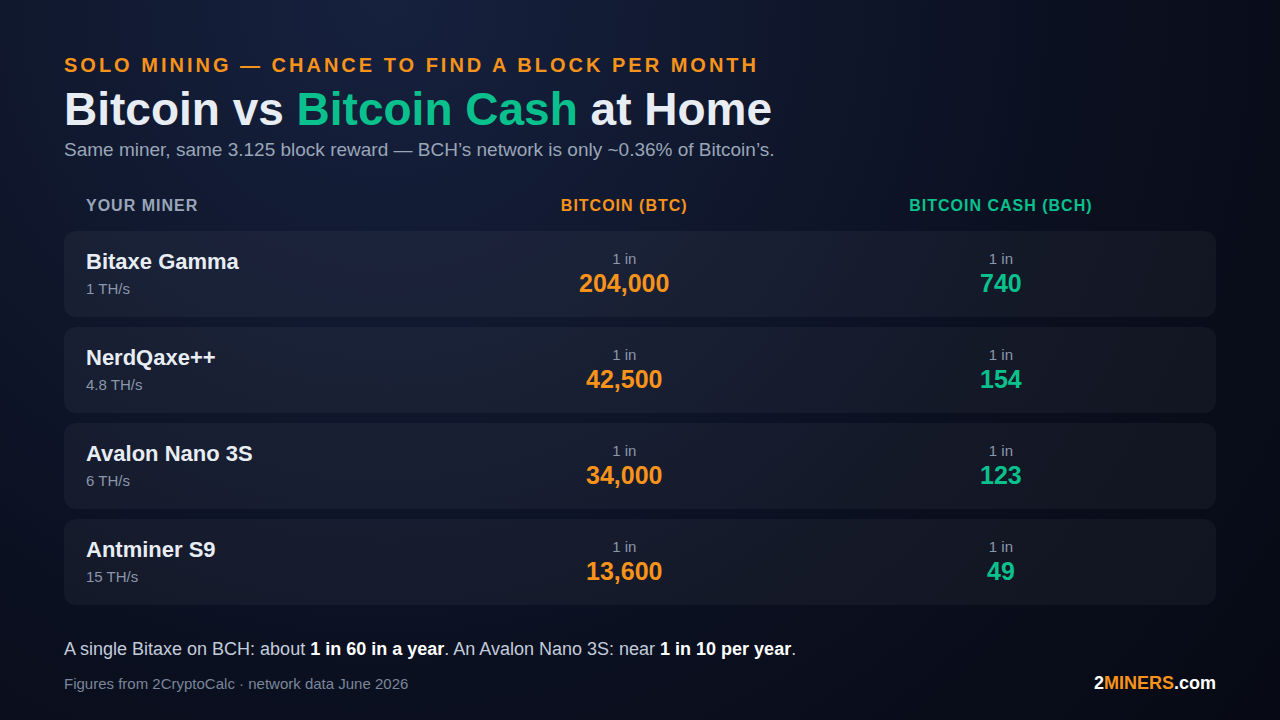
Put it in plain lottery terms. A single Bitaxe aimed at Bitcoin has roughly a 1 in 900 million chance on each block — true moonshot territory, but the prize is a whole 3.125 BTC. Aim that same Bitaxe at Bitcoin Cash and your odds climb to about 1 in 60 in a year. A quiet Avalon Nano 3S sits near 1 in 10 per year for a BCH block, and an Antminer S9 around 1 in 4. Those are real, human-scale odds — and a winning block pays the full 3.125 BCH even if it is nearly empty.
Want even better odds on the same SHA-256 hardware? Younger networks like Quai give a home miner a far bigger slice of the pie. See our guide to mining Quai on 2Miners.
Avalon Home Solo Mining in 3 Steps
Canaan’s Avalon Nano line is built for exactly this — managed entirely from the AvalonFamily app, no command line needed.
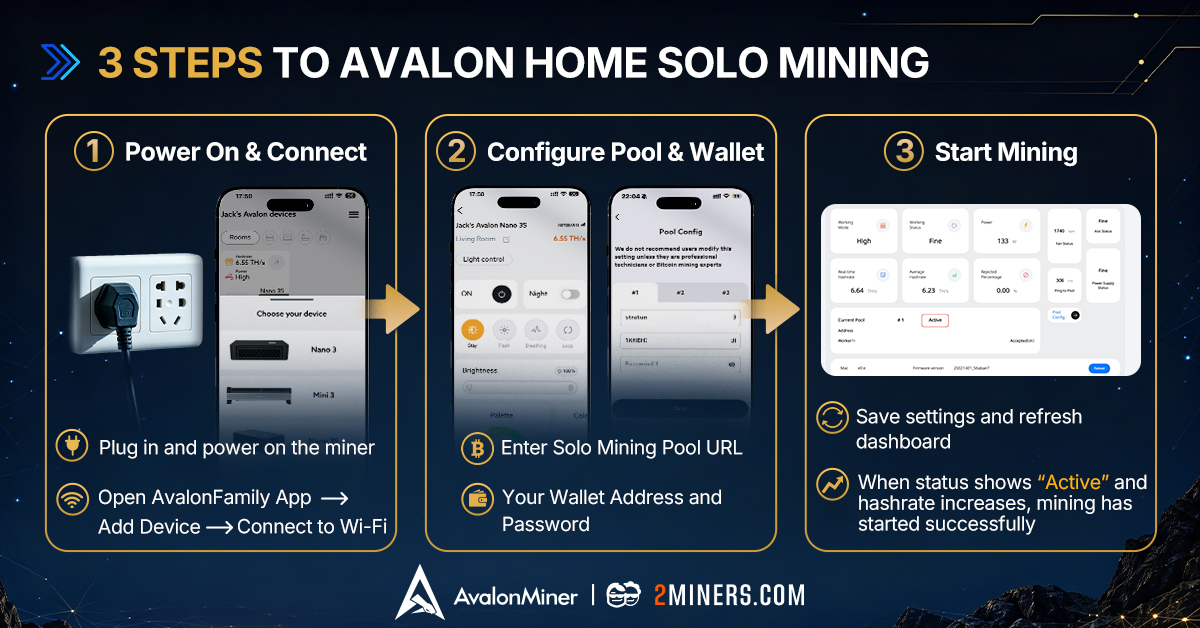
- Power on and connect. Plug in the miner, open the AvalonFamily app, add the device, and connect it to your Wi-Fi.
- Configure pool and wallet. Enter the solo mining pool URL, then your wallet address as the worker and x as the password.
- Start mining. Save and refresh the dashboard. When the status reads Active and the hashrate climbs, you are mining.
One word of caution that Avalon’s own screen gives you: do not change advanced frequency or voltage settings unless you genuinely know what you are doing. Stock settings are tuned for stability, and a bad overclock costs you uptime — which on a lottery miner means fewer tickets, not more.
Settings for 2Miners Solo Pools
Bitcoin (BTC) SOLO
Full reward, paid to whoever solves the block. Use the closest region:
- Europe: solo-btc.2miners.l1q3urman.workers.dev:2626
- USA: us-solo-btc.2miners.l1q3urman.workers.dev:2626
- Asia: asia-solo-btc.2miners.l1q3urman.workers.dev:2626
- Worker: your BTC wallet address
- Password: x
Pool page: 2Miners BTC SOLO.
Bitcoin Cash (BCH) SOLO
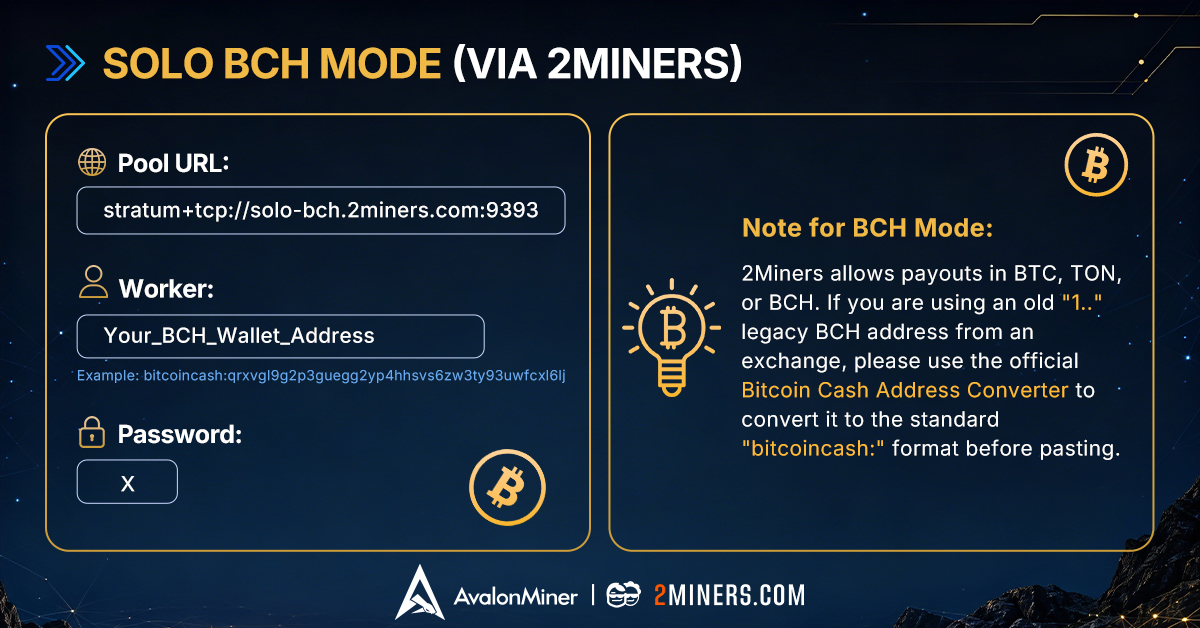
- Pool URL: stratum+tcp://solo-bch.2miners.l1q3urman.workers.dev:9393
- Worker: your BCH wallet address
- Password: x
Two things to know about BCH on 2Miners. First, you can take your payout in BTC, TON, or BCH — useful if you would rather accumulate Bitcoin while mining the easier network. Second, if you are pasting an old legacy “1…” address from an exchange, convert it to the modern “bitcoincash:” format with the official Bitcoin Cash Address Converter first, or the pool will not credit you.
Pool pages: BCH SOLO and BCH PPLNS. For more on getting paid in a different coin than you mine, see BTC payouts for altcoin mining.
Shared mining (PPLNS) pays you a steady trickle for the work you contribute — no luck involved. The problem at home is how small that trickle is. A Bitaxe mining Bitcoin in a shared pool earns on the order of 50 satoshis a day — a fraction of a cent. You will never feel it. That is not the pool’s fault; it is simply what 1 TH/s is worth against a zettahash network.
Solo flips the deal. Same miner, same power bill — but instead of dust every day, you hold a ticket on the entire block reward. Most days nothing happens. Then one block lands and you collect all 3.125 coins yourself. That is the whole point: shared pays you a little, guaranteed; solo pays you nothing, or a fortune. At home scale, where “a little” rounds to nothing anyway, the lottery shot is the rational fun.
This is exactly why Bitcoin Cash is the smart home target. Same miners, same 3.125 reward, but odds hundreds of times better — a genuine chance at a full block while you sleep, instead of a number with no zeroes in front of it. Run your exact miner through 2CryptoCalc to see both the shared payout and the solo probability for any hashrate, then pick your pool: BTC SOLO, BCH SOLO, or BCH shared.
Stay Updated
Follow us on X (Twitter) and join our Telegram chat to stay informed about new developments, miner alerts, and network upgrades.